
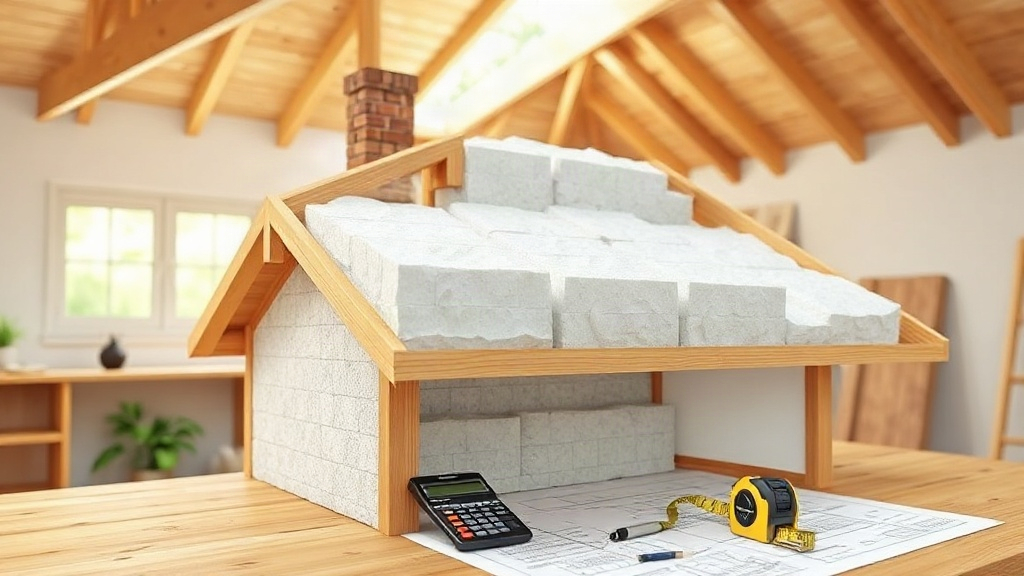
When you're planning to insulate your roof, the first question is often: how much insulation do I need? A roof insulation calculator can give you a solid estimate, turning vague ideas into concrete numbers. Whether you're a DIY enthusiast or a contractor, understanding the math behind insulation helps you avoid costly mistakes and ensures your home stays comfortable year-round. In this guide, we'll walk through using a calculator effectively, focusing on expanded polystyrene (EPS) as a popular choice. We'll also show you how an EPS insulation calculator can simplify your project planning.
Why Use a Roof Insulation Calculator?
Guessing insulation thickness or quantity often leads to either overspending or underperforming results. A calculator eliminates guesswork by factoring in your climate, roof area, and desired R-value (thermal resistance). For example, if you live in a cold climate, you'll need a higher R-value than someone in a mild region. The calculator translates that into specific thickness and material quantities. This is especially useful for EPS insulation, which comes in various densities and thicknesses. By inputting a few key details, you get a tailored recommendation that balances cost and performance.
Understanding EPS Insulation
EPS insulation is a rigid foam board made from expanded polystyrene beads. It's lightweight, affordable, and offers good thermal performance. Unlike extruded polystyrene (XPS), EPS has a slightly lower R-value per inch but costs less and is vapor-permeable, which can be advantageous in certain roof assemblies. Common applications include flat roofs, cathedral ceilings, and attic floors. When using an EPS insulation calculator, you'll need to know the R-value per inch of your specific EPS product, as densities vary. Typically, EPS ranges from R-3.6 to R-4.2 per inch.
Key Properties of EPS
- Thermal resistance: R-3.6 to R-4.2 per inch, depending on density.
- Moisture resistance: Good, but not a vapor barrier; can dry out if wet.
- Cost: Generally less expensive than XPS or polyiso.
- Environmental impact: Recyclable and often made with recycled content.
How to Use a Roof Insulation Calculator
Using a roof insulation calculator is straightforward. You'll typically need to input:
- Roof area: Measure the total square footage you plan to insulate.
- Climate zone or desired R-value: Check local building codes for minimum requirements.
- Insulation type: Select EPS and its density (e.g., 1 lb/ft³ or 2 lb/ft³).
- Thickness: The calculator may suggest a thickness based on your R-value goal.
Once you enter these details, the calculator outputs the number of boards needed, total R-value, and sometimes estimated energy savings. For an EPS insulation calculator, you might also get the total weight and volume for shipping.
Step-by-Step Example
Let's say you have a 1,000 sq ft roof and want an R-value of 30. Using EPS with R-4 per inch, you'd need 7.5 inches of thickness. An EPS insulation calculator would then tell you how many 2-inch boards (for example) to buy. If each board covers 8 sq ft, you'd need 125 boards. This precision prevents over-ordering and reduces waste.
Factors That Affect Your Calculation
Several variables can influence the accuracy of your calculator results. Ignoring them might lead to under-insulation or unnecessary expense.
Climate and Building Codes
Your local climate dictates the minimum R-value required. For instance, the International Energy Conservation Code (IECC) specifies different R-values for different zones. Always check with your local building department before finalizing your plan. A good roof insulation calculator will let you adjust for climate zone.
Roof Type and Slope
Flat roofs, pitched roofs, and cathedral ceilings each have unique insulation needs. For flat roofs, EPS boards are often laid over the deck, while pitched roofs might use insulation between rafters. The calculator should account for these differences, but you may need to adjust for slope and access.
Moisture and Ventilation
EPS is vapor-permeable, so in cold climates, a vapor barrier might be needed to prevent condensation. Proper ventilation is also crucial to avoid moisture buildup. These factors don't directly affect the calculator's output but are essential for a successful installation.
Beyond the Calculator: Ensuring Success
While a calculator gives you numbers, real-world installation requires attention to detail. Here are some tips:
- Seal air leaks: Insulation works best when air infiltration is minimized. Caulk gaps and seal penetrations before installing EPS.
- Use proper fasteners: EPS boards need appropriate screws and washers to stay secure.
- Layer correctly: For multiple layers, stagger joints to reduce thermal bridging.
- Consult a pro: If you're unsure, hire a professional to verify your calculations and installation.
Frequently Asked Questions
How do I calculate the R-value of EPS insulation?
R-value is the thickness of the material multiplied by its R-value per inch. For EPS, R-value per inch ranges from 3.6 to 4.2. So, a 2-inch board with R-4 per inch gives R-8. Always check the manufacturer's specifications for the exact value.
Can I use a roof insulation calculator for different insulation types?
Yes, most calculators allow you to select the material. However, the R-value per inch varies: EPS is around R-4, XPS about R-5, and polyiso up to R-6.5. Adjust your inputs accordingly.
What thickness of EPS do I need for my roof?
It depends on your target R-value. For example, to achieve R-30 with EPS at R-4 per inch, you need 7.5 inches. Building codes often specify minimum R-values for roofs; check local requirements.
Is EPS insulation suitable for flat roofs?
Yes, EPS is commonly used on flat roofs. It can be installed under a protective membrane. Ensure proper drainage and consider adding a cover board to distribute weight.
How accurate are online insulation calculators?
They provide good estimates but should be verified with a professional. Factors like thermal bridging, air leaks, and installation quality can affect actual performance. Use the calculator as a starting point, then consult an expert for final design.
With the right tools and knowledge, insulating your roof with EPS can be a rewarding project. A roof insulation calculator and an EPS insulation calculator are invaluable for planning. They help you make informed decisions, save money, and improve your home's energy efficiency. So before you buy materials, run the numbers and enjoy a cozier, greener home.