
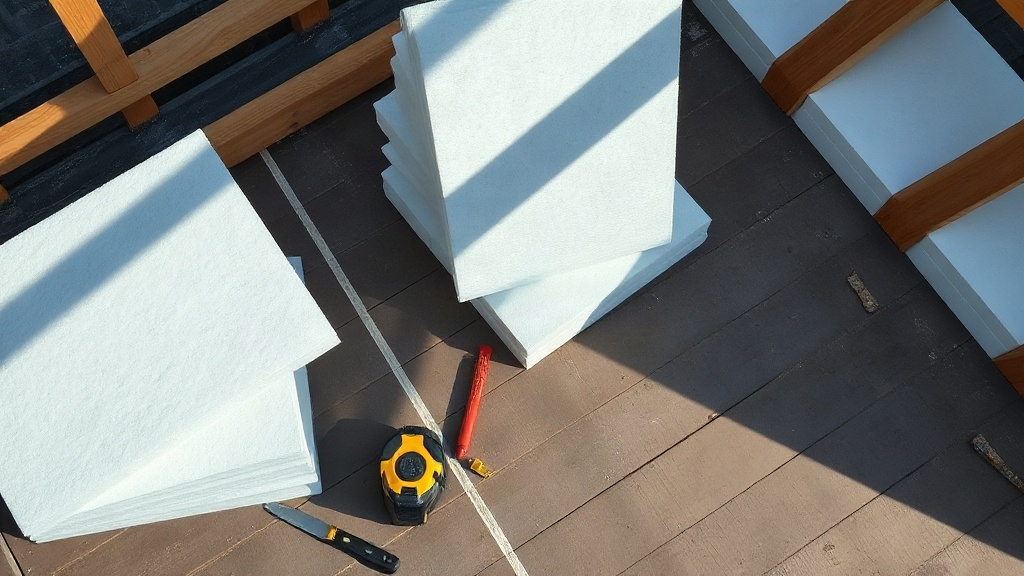
Most homeowners decide to insulate a roof long before they know what that decision actually costs in thickness, boards and euros. A roof insulation calculator closes that gap. It converts a rough intention like "the attic feels cold in January" into a specific answer: how many millimetres of material you need, how many boards to order, and roughly what the whole thing will set you back. Get the inputs right and the estimate holds up surprisingly well against real quotes.
This guide walks through how these calculators work, why eps insulation is often the material people plug into them, and the details that quietly wreck an otherwise good calculation.
What a Roof Insulation Calculator Actually Does
At its core, the tool runs one equation you would otherwise do by hand: required thickness equals target thermal resistance multiplied by the material's thermal conductivity. That is it. Everything else in a good calculator is there to help you supply the right numbers for that equation.
In practice, a decent calculator asks for four things:
- The area of the roof or ceiling you plan to cover, in square metres.
- The material you intend to use, since each one conducts heat differently.
- Your target U-value, the figure building regulations usually specify.
- Whether you are insulating between rafters, above them, or flat across a ceiling.
From those inputs it returns a thickness, a board count, and often a rough cost. The thickness number is the one that matters most, because it drives everything downstream: the boards you buy, the fixings you need, and whether the whole assembly still fits in the space you have.
Why EPS Insulation Shows Up in So Many Calculations
eps insulation is expanded polystyrene, the rigid white foam board you have probably seen stacked in builders' yards. Its thermal conductivity sits around 0.031 to 0.038 W/mK depending on density and grade, which is competitive without being exceptional. What makes it a frequent choice is the combination of price, availability and how predictable it is to work with.
Three properties matter when you feed EPS into a calculation:
- Stable conductivity. EPS does not absorb much moisture, so its rated performance holds up better than materials that soak up damp.
- Cheap thickness. Because the boards cost relatively little per cubic metre, hitting a high R-value with EPS is often cheaper than doing the same with denser foams or mineral wool.
- Light weight. A 100 mm EPS board weighs very little, which matters when you are carrying it up a ladder.
The trade-off is that EPS needs more thickness than polyurethane or phenolic boards to reach the same U-value. A calculator will make that gap obvious within seconds, which is genuinely useful when you are comparing options.
A Quick Worked Example
Say you want a U-value of 0.16 W/m²K on a flat ceiling and you are using EPS with a conductivity of 0.035 W/mK. Divide the conductivity by the target U-value and you get roughly 0.22 metres, or 220 mm. In practice you would use two layers of 110 mm, or 100 mm plus 120 mm, staggered so the joints do not line up.
Change the material to something with a conductivity of 0.022 and the required thickness drops to about 140 mm. That is the kind of comparison an eps insulation calculator handles instantly, and it is the reason people run two or three scenarios before ordering anything.
Getting the Inputs Right
A calculator is only as good as what you feed it, and most errors happen before anyone touches the numbers.
Measure the Real Area
Roof area is not floor area. A pitched roof has more surface than the footprint beneath it, and the difference grows as the pitch steepens. Measure along the slope, not across the plan. For a simple gable roof, slope length times ridge length gives you one side; double it for the full roof.
Know Your Target U-Value
Building regulations set minimum standards, and they vary by country and by whether you are renovating or building new. If you are unsure, check your local requirements or ask your installer. Aiming slightly above the minimum is usually sensible, since the extra material cost is small compared with the labour.
Account for Timber
Rafters and joists conduct heat far better than insulation does. If you are insulating between timbers, the effective U-value of the whole roof will be worse than the calculator's clean number suggests. A well-built roof insulation calculator will ask about rafter spacing and percentage, or at least warn you that the raw figure needs adjusting.
Common Mistakes That Distort the Result
Even careful users run into the same handful of problems.
- Mixing up R and U. They are inverses of each other. A higher R-value means better insulation; a higher U-value means worse. Swapping them produces nonsense.
- Ignoring thermal bridging. Gaps, metal fixings and uninsulated lintels all leak heat. No calculator can fix a badly detailed installation.
- Forgetting ventilation. A cold roof needs airflow above the insulation to avoid condensation. Adding 200 mm of EPS without addressing ventilation can create damp problems worse than the heat loss you were solving.
- Rounding thickness down. If the maths says 217 mm, order 220 mm, not 200 mm. Small shortfalls add up across a whole roof.
From Numbers to a Real Quote
Once you have a thickness and a board count, the rest of the estimate falls into place. Add fixings, a vapour control layer if your build-up needs one, and the labour rate for your area. If you are doing the work yourself, price in a respirator, gloves and a decent cutting knife, because EPS dust is unpleasant and the boards are fiddly to cut cleanly without the right blade.
It also helps to run the calculation twice: once with the minimum compliant thickness, and once with a thicker option. The extra cost is often modest, and the reduction in heating demand over a decade usually justifies it. That comparison is the single most valuable thing a calculator gives you.
Frequently Asked Questions
How accurate is a roof insulation calculator?
For thickness and material quantity, it is typically accurate to within a few percent, provided your measurements and U-value target are correct. Cost estimates are rougher, because board prices and labour rates vary by region and supplier.
Can I use an EPS insulation calculator for a pitched roof?
Yes, but you need to tell it how the insulation sits. Insulating between rafters, above rafters and across a flat ceiling all produce different results, mainly because of how much timber is in the thermal path.
What thickness of EPS insulation do I need for a roof?
It depends entirely on your target U-value. For a typical retrofit target around 0.16 W/m²K, expect roughly 200 to 230 mm of standard EPS, split across two staggered layers.
Is EPS insulation suitable for a warm roof build-up?
Generally yes. EPS is often used above the deck in warm roof constructions, where a single continuous layer avoids the thermal bridging that comes with insulating between rafters.
Does the calculator account for the existing insulation?
Only if you enter it. Existing mineral wool or old foam adds resistance to the assembly, and ignoring it will push you toward unnecessary thickness. Measure what is already there before you start.