
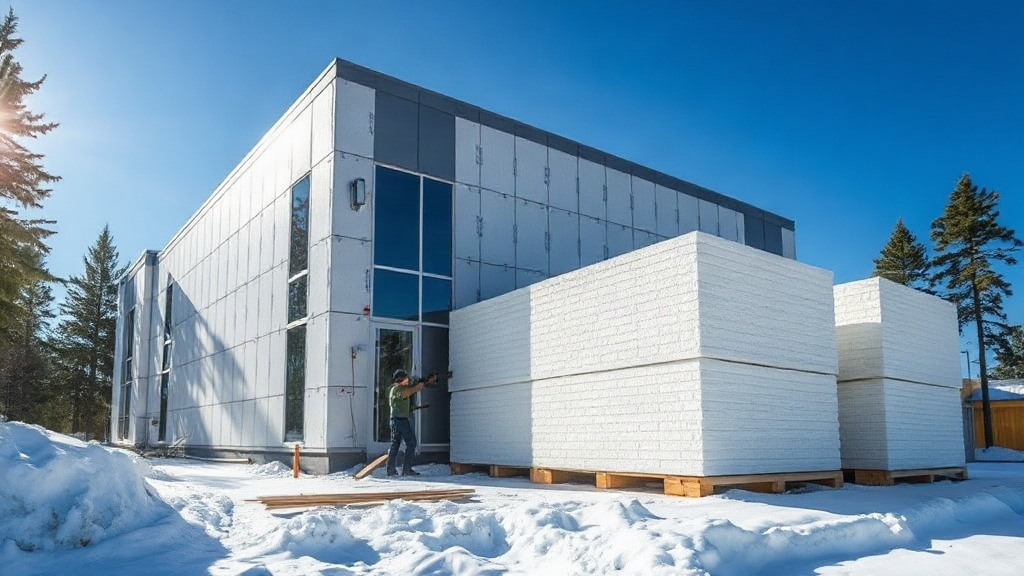
When the mercury dips to -30°C and the wind howls across the prairies, your building's insulation is the only thing standing between you and astronomical heating bills. In Canada, where heating degree days can exceed 5,000 in many regions, the choice of insulation material isn't just a detail, it's a make-or-break decision. Among the options, EPS insulation has quietly become a workhorse for builders and renovators who need reliable performance without breaking the bank. But how does it actually hold up in our climate, and where does it fit best? Let's dig in.
What Makes EPS Insulation a Smart Choice for Canadian Weather?
EPS, or expanded polystyrene, is a rigid foam board made from tiny beads of polystyrene that are expanded with steam and molded together. The result is a lightweight, closed-cell structure that traps air and resists heat flow. Unlike some insulation types that lose performance when temperatures plummet, EPS maintains its R-value reasonably well in cold conditions. In fact, studies show that EPS retains over 90% of its thermal resistance at temperatures as low as -20°C. That's critical when you're designing for a Canadian winter, where the temperature difference between inside and outside can be 50 degrees or more.
Another advantage is moisture resistance. EPS doesn't absorb water readily, so it won't turn into a soggy mess if it gets damp during construction or from minor leaks. That's a big deal in coastal BC or the Atlantic provinces, where rain and humidity are constant companions. And because EPS is chemically inert, it won't rot, mold, or attract pests. For a material that's often hidden behind drywall or cladding, that kind of durability is exactly what you want.
EPS Insulation in Sandwich Panels: A Match Made in Canada
If you've driven past a new warehouse, cold storage facility, or even a modern farm building lately, you've probably seen sandwich panels canada style. These prefabricated panels consist of two rigid facings (often metal) bonded to an insulating core. EPS is one of the most popular core materials because it's lightweight, cost-effective, and easy to cut and install. For Canadian projects, sandwich panels with EPS cores offer several benefits:
- Fast installation: Panels arrive ready to assemble, which shortens construction time and reduces labor costs. In remote areas where skilled trades are scarce, that's a huge plus.
- Consistent R-value: Unlike batt insulation, which can be compressed or leave gaps, EPS cores provide uniform thermal performance across the entire panel.
- Design flexibility: EPS can be molded into various thicknesses and shapes, allowing for custom panel profiles that meet specific architectural or structural requirements.
- Moisture management: The closed-cell nature of EPS helps prevent moisture migration, reducing the risk of condensation within the wall or roof assembly.
When specifying sandwich panels for a Canadian project, pay attention to the density of the EPS core. Higher density (e.g., 1.5 lb/ft³ or more) offers better compressive strength and dimensional stability, which matters for load-bearing applications. Also, check that the panel meets local building codes for fire performance. While EPS is combustible, it can be treated with flame retardants, and in many assemblies, it's protected by a thermal barrier such as gypsum board.
Insulated Roof Panels: The Backbone of Energy-Efficient Roofs
Roofs are where the biggest heat losses occur in most buildings, and that's especially true in Canada, where snow loads and freeze-thaw cycles add another layer of complexity. Insulated roof panels are a game-changer because they combine structural support, insulation, and weatherproofing in a single component. These panels typically feature an EPS core sandwiched between metal or plywood skins, and they're designed to span between purlins or rafters without additional framing.
The advantages of insulated roof panels for Canadian buildings are compelling:
- Elimination of thermal bridging: Because the insulation is continuous, there are no studs or joists to conduct heat through. That can improve the effective R-value by 20-30% compared to traditional roof assemblies.
- Speed of construction: Panels can be installed quickly, even in cold weather, which extends the building season in northern regions.
- Integrated water management: Many panels come with factory-applied weatherproofing and interlocking joints that shed water and snow effectively.
- Vaulted ceilings: Exposed fasteners and clean lines make them ideal for commercial spaces, agricultural buildings, and even some residential designs where an open, industrial look is desired.
When choosing insulated roof panels, consider the snow load requirements for your area. In Canada, ground snow loads can range from 1.0 kPa in mild coastal areas to over 4.0 kPa in northern Quebec and Labrador. The panel's span capacity and the EPS core's compressive strength must be adequate to handle these loads without deflection. Also, think about thermal movement: metal skins expand and contract with temperature changes, so fasteners and joints need to accommodate that movement to prevent leaks.
How Does EPS Compare to Other Insulation Materials?
EPS often gets compared to XPS (extruded polystyrene) and polyisocyanurate (polyiso). Here's a quick rundown:
- XPS: Slightly higher R-value per inch (around R-5 vs. R-4 for EPS), but more expensive and less environmentally friendly due to blowing agents with high global warming potential.
- Polyiso: Higher R-value per inch (R-6 to R-6.5), but its performance drops significantly in cold temperatures, making it less ideal for Canadian winters unless used in thicker layers.
- Mineral wool: Excellent fire resistance and sound absorption, but heavier and more expensive, and it can lose R-value if it gets wet.
For most Canadian applications, EPS hits a sweet spot: good thermal performance, moisture resistance, affordability, and easy availability. It's also one of the most recycled insulation materials, which appeals to projects aiming for green certification.
Practical Tips for Installing EPS Insulation in Canada
Getting the most out of EPS requires attention to detail during installation. Here are some field-tested recommendations:
- Seal all joints: Use expanding foam or high-quality tape to seal gaps between EPS boards. Even small gaps can reduce performance by allowing air leakage.
- Manage moisture: Although EPS resists water, the assembly around it must be designed to drain. Include a drainage plane and flashing details to direct water away.
- Protect from UV: EPS degrades when exposed to sunlight. Cover it with cladding, roofing, or a suitable coating within 30 days.
- Consider thermal barriers: For interior applications, install a code-approved thermal barrier (like 12.7 mm gypsum board) over EPS to meet fire safety requirements.
- Account for thermal bridging: Use continuous insulation wherever possible, especially in wood-frame construction. The EPS Insulation Calculator can help you determine the right thickness to achieve your target R-value.
Frequently Asked Questions
Does EPS insulation lose R-value in extreme cold?
EPS performs well in cold temperatures, retaining over 90% of its R-value at -20°C. However, like all materials, its performance can decline slightly as temperatures drop further. For Canadian winters, it's still a reliable choice.
Can EPS sandwich panels be used for both walls and roofs?
Yes, EPS sandwich panels are versatile and can be used for walls, roofs, and even floors. For roofs, ensure the panels are rated for the expected snow load and have appropriate weather sealing.
Are insulated roof panels with EPS suitable for residential homes?
Absolutely. They are increasingly popular in residential construction, especially for additions, garages, and modern homes with vaulted ceilings. They offer excellent energy efficiency and can be finished with various interior and exterior materials.
How do I calculate the right thickness of EPS for my Canadian project?
Thickness depends on your target R-value, which varies by climate zone. Use an EPS insulation calculator or consult a building science professional to determine the optimal thickness for your location and assembly.
Is EPS insulation environmentally friendly?
EPS is recyclable and has a lower environmental impact compared to some other foam insulations. It contains no HCFCs or CFCs and requires less energy to produce than many alternatives.